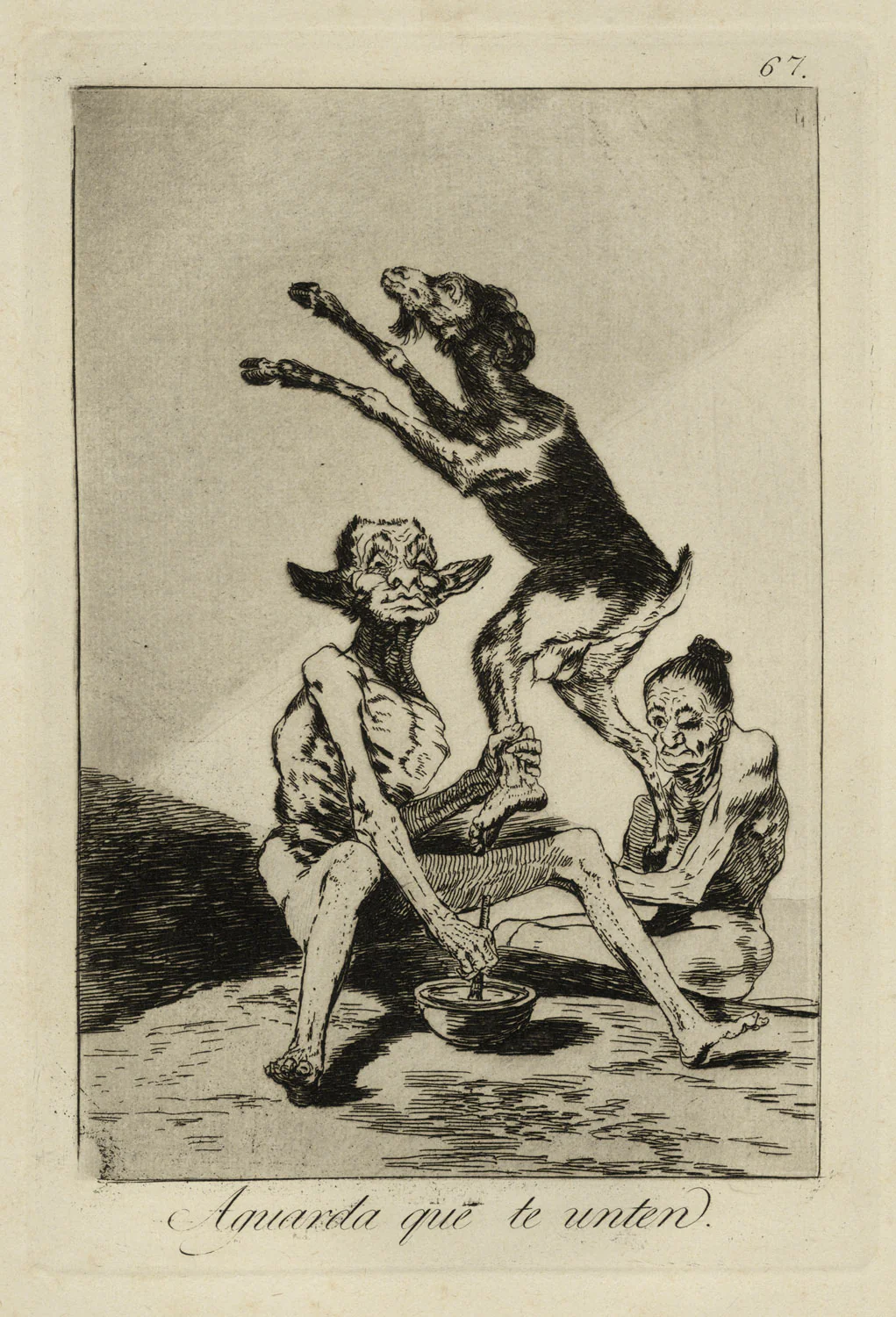

Aguarda Que Te Unten
Wait till you've been anointed
He has been sent out on an important errand and wants to go off half-anointed. Even among the witches, some are hare-brained, impetuous, mad cap, without a scrap of judgment. It’s the same the world over.
Etching with aquatint from Goya's most recogniseable suite Los Caprichos.
These etchings were published between 1881-1886 in an edition of 210 by the Calcografia for the Real Academia and are from the fifth edition.
The suite was first published in 1799 and Goya is thought to have sold only 27 copies before withdrawing it from circulation due to the Inquisition. Most of the remaining copies of the edition were alter purchased by King Charles IV of Spain. The work was an enlightened, tour-de-force critique of 18th century Spain, and humanity in general. The informal style as well as the depiction of contemporary society found in the Caprichos, makes them and Goya himself, a precursor to the modernist movement almost a century later.
Original: $2,640.46
-65%$2,640.46
$924.16Product Information
Product Information
Shipping & Returns
Shipping & Returns
Description
Wait till you've been anointed
He has been sent out on an important errand and wants to go off half-anointed. Even among the witches, some are hare-brained, impetuous, mad cap, without a scrap of judgment. It’s the same the world over.
Etching with aquatint from Goya's most recogniseable suite Los Caprichos.
These etchings were published between 1881-1886 in an edition of 210 by the Calcografia for the Real Academia and are from the fifth edition.
The suite was first published in 1799 and Goya is thought to have sold only 27 copies before withdrawing it from circulation due to the Inquisition. Most of the remaining copies of the edition were alter purchased by King Charles IV of Spain. The work was an enlightened, tour-de-force critique of 18th century Spain, and humanity in general. The informal style as well as the depiction of contemporary society found in the Caprichos, makes them and Goya himself, a precursor to the modernist movement almost a century later.