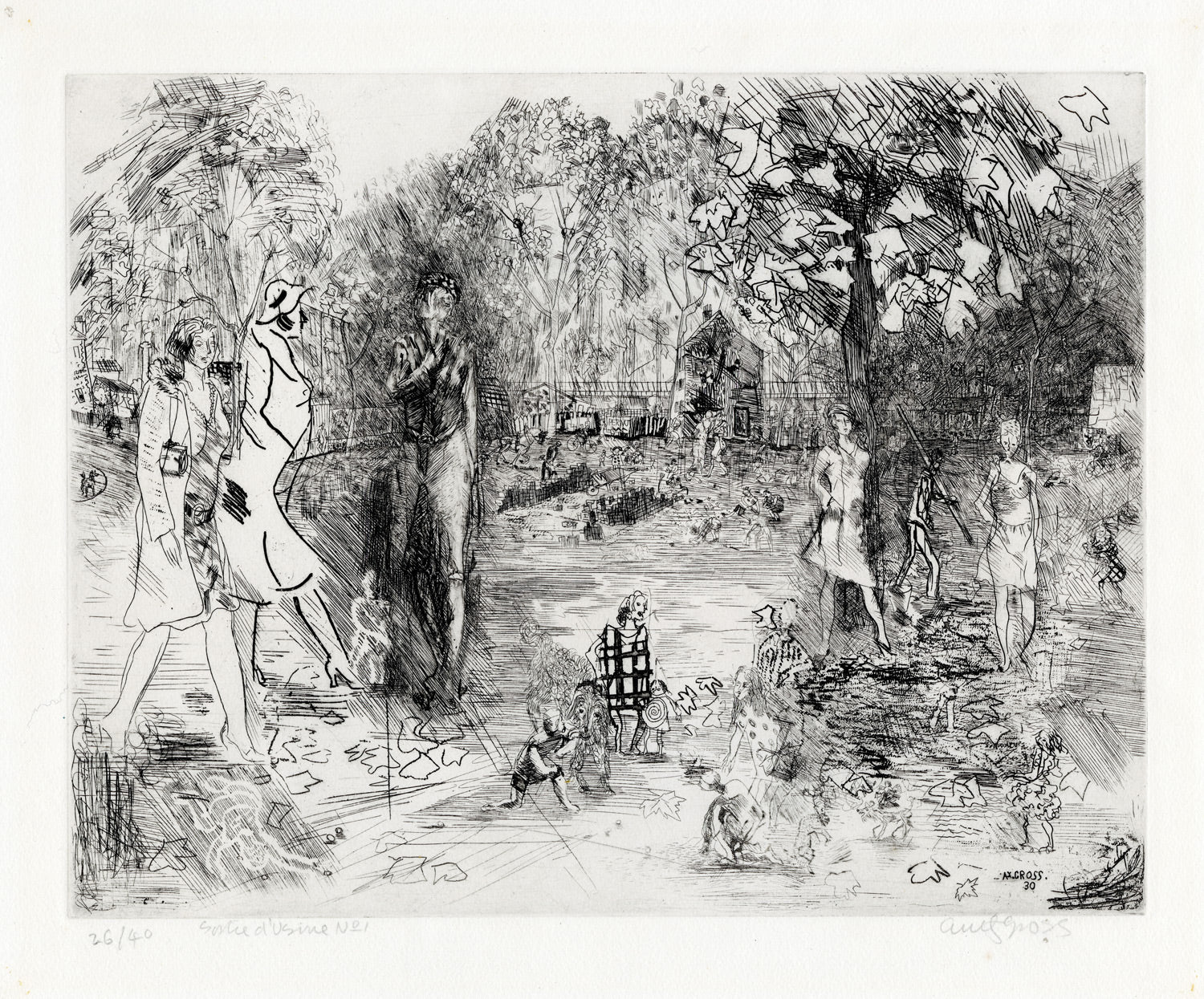
Sortie d'Usine No. 1
Signed etching from an edition of 40 only.
During the 1930s Gross’s etching and painting came to achieve a kind of equipoise: one medium might reciprocally feed the other, and this was especially true of the etchings following the La Zone oils, a series of observations of daily life in a Parisian workers’ slum. The energy and confidence of these 1930 narrative figure paintings marked a new stage in Gross’s work in oils, but the etched versions that quickly followed were hardly slavish copies: they were genuine originals in their own right, absorbing and affecting extensions of the paintings, using unusual etching techniques that challenged accepted canons in printmaking. Julian Freeman, 2021.
During the 1930s Gross’s etching and painting came to achieve a kind of equipoise: one medium might reciprocally feed the other, and this was especially true of the etchings following the La Zone oils, a series of observations of daily life in a Parisian workers’ slum. The energy and confidence of these 1930 narrative figure paintings marked a new stage in Gross’s work in oils, but the etched versions that quickly followed were hardly slavish copies: they were genuine originals in their own right, absorbing and affecting extensions of the paintings, using unusual etching techniques that challenged accepted canons in printmaking. Julian Freeman, 2021.
$1,752.27
Original: $5,006.48
-65%Sortie d'Usine No. 1—
$5,006.48
$1,752.27Product Information
Product Information
Shipping & Returns
Shipping & Returns
Description
Signed etching from an edition of 40 only.
During the 1930s Gross’s etching and painting came to achieve a kind of equipoise: one medium might reciprocally feed the other, and this was especially true of the etchings following the La Zone oils, a series of observations of daily life in a Parisian workers’ slum. The energy and confidence of these 1930 narrative figure paintings marked a new stage in Gross’s work in oils, but the etched versions that quickly followed were hardly slavish copies: they were genuine originals in their own right, absorbing and affecting extensions of the paintings, using unusual etching techniques that challenged accepted canons in printmaking. Julian Freeman, 2021.
During the 1930s Gross’s etching and painting came to achieve a kind of equipoise: one medium might reciprocally feed the other, and this was especially true of the etchings following the La Zone oils, a series of observations of daily life in a Parisian workers’ slum. The energy and confidence of these 1930 narrative figure paintings marked a new stage in Gross’s work in oils, but the etched versions that quickly followed were hardly slavish copies: they were genuine originals in their own right, absorbing and affecting extensions of the paintings, using unusual etching techniques that challenged accepted canons in printmaking. Julian Freeman, 2021.