The Eavesdropping Sea
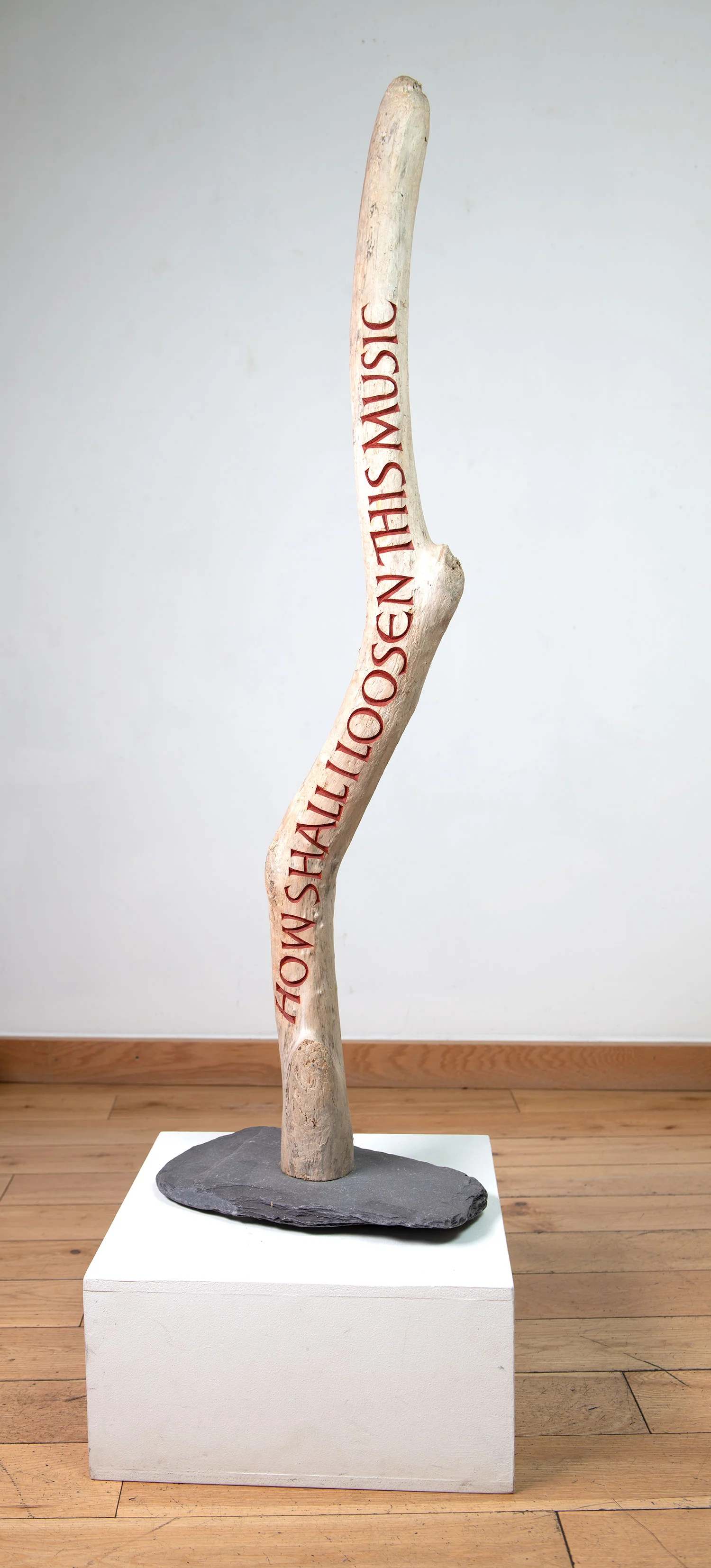
Signed verso driftwood, probably sycamore, red ochre acrylic on a base of sea-worn slate.
Although Martin works with a lot of found and discarded wood, it is not very often that he comes across a piece which can be worked on with no preparation. Found on Criccieth beach, the only work to be done was to cut the base straight so it could stand up. Erect, the wood looked like a signpost. It reminded Martin of Vernon Watkins' poem Taliesin in Gower, in which the mythical poet muses on himself, his past, his world and his music. The words here are the envoi; the last line of the poem.
The pale wood looked rather like a bone, calling to mind the palaeolithic skeleton found at Paviland on Gower (of which Watkins also wrote). It was coloured with red ochre, a pigment which seems to have symbolised life for many ancient peoples, so Wenham used this in the letters to make another link to Watkins, his poems and his homeland.
Original: $3,550.36
-65%$3,550.36
$1,242.63Product Information
Product Information
Shipping & Returns
Shipping & Returns
Description
Signed verso driftwood, probably sycamore, red ochre acrylic on a base of sea-worn slate.
Although Martin works with a lot of found and discarded wood, it is not very often that he comes across a piece which can be worked on with no preparation. Found on Criccieth beach, the only work to be done was to cut the base straight so it could stand up. Erect, the wood looked like a signpost. It reminded Martin of Vernon Watkins' poem Taliesin in Gower, in which the mythical poet muses on himself, his past, his world and his music. The words here are the envoi; the last line of the poem.
The pale wood looked rather like a bone, calling to mind the palaeolithic skeleton found at Paviland on Gower (of which Watkins also wrote). It was coloured with red ochre, a pigment which seems to have symbolised life for many ancient peoples, so Wenham used this in the letters to make another link to Watkins, his poems and his homeland.