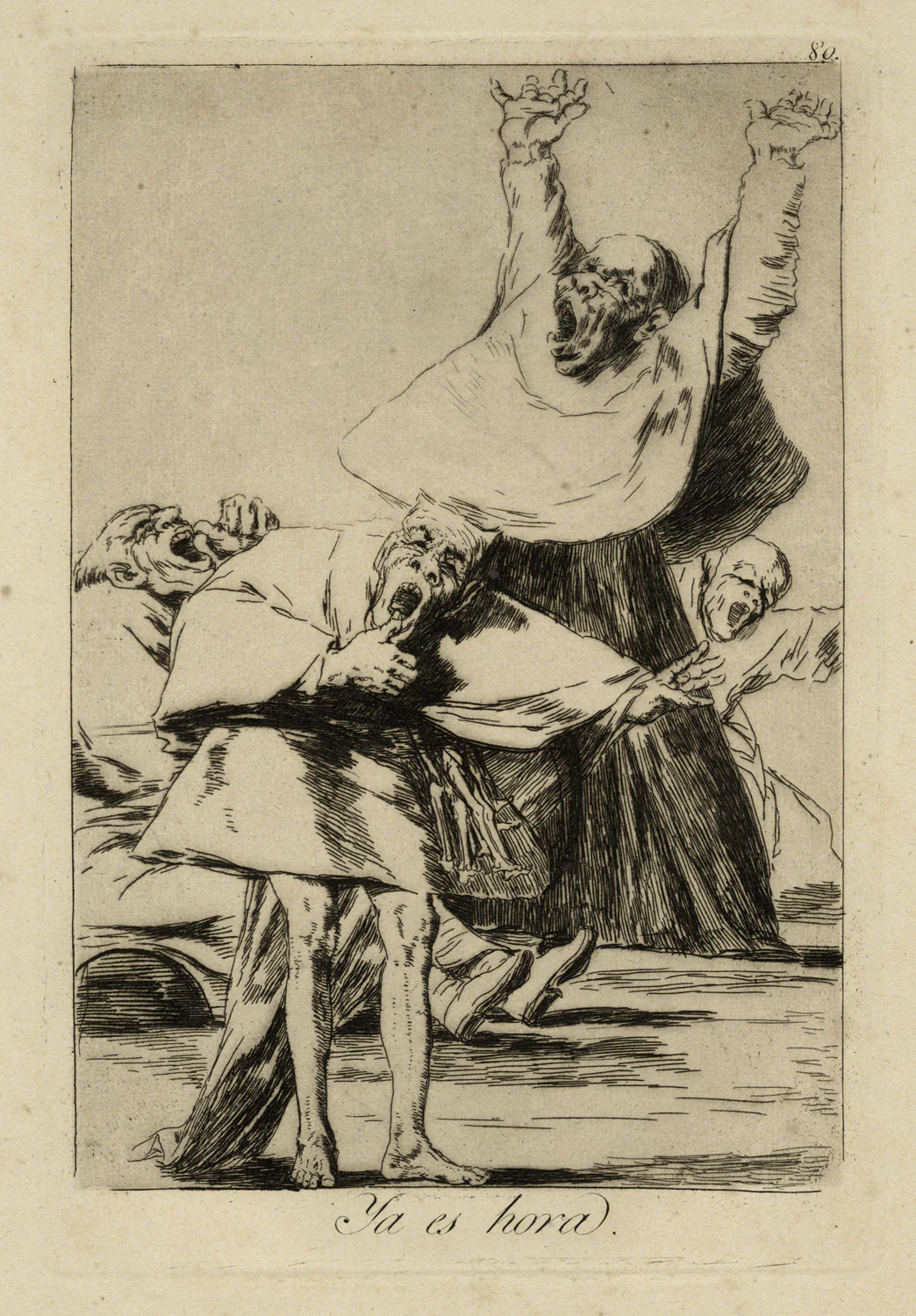

Ya Es Hora
It is time
Then, when dawn threatens, each one goes on his way, Witches, Hobgoblins, apparitions and phantoms. It is a good thing that these creatures do not allow themselves to be seen except by night and when it is dark! Nobody has been able to find out where they shut themselves up and hide during the day. If anyone could catch a denful of Hobgoblins and were to show it in a cage at 10 o’clock in the morning in the Puerto del Sol, he would need no other inheritance.
Etching with aquatint from Goya's most recogniseable suite Los Caprichos.
These etchings were published between 1881-1886 in an edition of 210 by the Calcografia for the Real Academia and are from the fifth edition.
The suite was first published in 1799 and Goya is thought to have sold only 27 copies before withdrawing it from circulation due to the Inquisition. Most of the remaining copies of the edition were alter purchased by King Charles IV of Spain. The work was an enlightened, tour-de-force critique of 18th century Spain, and humanity in general. The informal style as well as the depiction of contemporary society found in the Caprichos, makes them and Goya himself, a precursor to the modernist movement almost a century later.
Original: $2,640.46
-65%$2,640.46
$924.16Product Information
Product Information
Shipping & Returns
Shipping & Returns
Description
It is time
Then, when dawn threatens, each one goes on his way, Witches, Hobgoblins, apparitions and phantoms. It is a good thing that these creatures do not allow themselves to be seen except by night and when it is dark! Nobody has been able to find out where they shut themselves up and hide during the day. If anyone could catch a denful of Hobgoblins and were to show it in a cage at 10 o’clock in the morning in the Puerto del Sol, he would need no other inheritance.
Etching with aquatint from Goya's most recogniseable suite Los Caprichos.
These etchings were published between 1881-1886 in an edition of 210 by the Calcografia for the Real Academia and are from the fifth edition.
The suite was first published in 1799 and Goya is thought to have sold only 27 copies before withdrawing it from circulation due to the Inquisition. Most of the remaining copies of the edition were alter purchased by King Charles IV of Spain. The work was an enlightened, tour-de-force critique of 18th century Spain, and humanity in general. The informal style as well as the depiction of contemporary society found in the Caprichos, makes them and Goya himself, a precursor to the modernist movement almost a century later.